
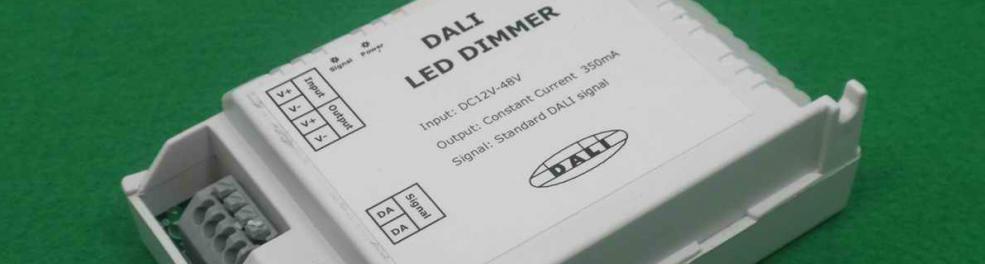
The DALI protocol was developed to replace the widely used 1-10V analog protocol. DALI complies with IEC 60929, the International Electrotechnical Commission standard for electronic ballasts of fluorescent lamps. Any equipment that supports the DALI interface can communicate independently with the DALI bus. DALI controllers can query the status of each device and issue commands to it using bidirectional data exchange. As a standalone system, a single DALI line can run up to 64 independent devices. The number of addresses in the system can be increased to 12800 by using DALI Routers (combining up to 200 DALI lines). A DALI line can also be used as part of another smart home system, connecting to it via DALI gateways.
- DALI is an open protocol available to all manufacturers.
- Only two wires are needed to form the communication bus for all devices in a DALI network, and there is no need to observe polarity.
- The DALI protocol was designed specifically for lighting control.
- Not being a high-speed network, DALI allows any cable network topology, including mixed ones. No terminators are required at the ends of the lines either.
- DALI is a decentralized bus, meaning it has no central controller. Each DALI device has non-volatile memory that stores its settings: address, group membership, and scene levels.
- The DALI system is not defined as an exclusively low-current system under IEC 61140 (safety extra-low voltage) and can therefore run alongside power lines, or even use some cores of multi-core power cables. The DALI line is also protected against accidental connection of a power line.
- The DALI signal has a high signal-to-noise ratio, which allows high-level noise to have no harmful effect.
- DALI offers three ways of addressing commands: individual, group, and broadcast. Commands themselves can specify not only a particular level but also a pre-recorded scene. This approach greatly reduces the amount of information transmitted over the DALI bus.
- Commands have the format "address, command", for example: "group1, 100%" or "ALL, Scene1".
- A single DALI line supports up to 64 independent devices; building larger systems requires DALI Routers, which can combine up to 200 DALI subsystems.
- DALI lighting control systems can be easily integrated into other building automation and management systems, such as LON, KNX, BACnet.