
A smart energy grid will prepare the world for life after oil
So why does energy saving matter? A new building has just been completed. Yet, as the speaker noted, from its very first day it requires substantial funds for upkeep. In other words, construction itself is far from the largest share of spending over a building's life cycle: construction accounts for only 20%, while operation accounts for a full 80%.
People usually try to economize at the construction stage — say, by 5%. But it is clearly better to cut those same 5% from operating costs instead. The most expensive part of running a building is energy consumption, and it is no secret that a large share of that energy is wasted for no reason at all.
To grasp the scale of these costs and losses, one need only look at global energy consumption statistics, where the main «absorbers» of energy are residential and commercial buildings. Paradoxically, neither industry nor transport comes anywhere near holding the record here.
Energy losses typically arise from poor building design, low-quality or unsuitable building materials, shoddy construction, and the notorious human factor.
Now, one of the most effective ways to save energy is to replace people with automation that controls heating, ventilation, and lighting. And energy efficiency is not just a buzzword or a marketing gimmick: since the cost of saving energy is 3-4 times lower than the cost of generating the same amount, there is simply no alternative to moving in this direction.
Real, laboratory-verified figures for energy savings achieved through automation are impressive. An individual (room) thermostat cuts everyday energy consumption by 50%. Heating system automation — by 40%. Blind control — by 45%. Lighting automation — by 80%. Ventilation automation — by 60%.
Clearly, spending on automation is an investment, and so it should be measured not in rubles, like ordinary expenses, but through ROI (return on investment). These investments have a certain payback period, after which they begin to generate «profit».
What do such savings mean for the «private consumer»? The ability to lower regular expenses and spend the money in the «market» — that is, to genuinely raise one's standard of living and, indirectly, help the state address the problems of a stagnating market.
What do energy savings mean for a municipality? Above all, the opportunity to invest freed-up funds in important infrastructure projects that never have enough money.
What makes sense to tackle first? Heating and hot water account for 85% of a building's energy consumption; lighting for 15%.
There are several ways to improve a building's energy efficiency. The first is insulating existing buildings: it delivers good results but has a long payback period, usually ten to 40 years. The second is upgrading the existing heating/ventilation system: average results, with payback in five to 15 years. The third is an intelligent building management system (based on calculations for KNX-technology systems): substantial savings, with payback typically in one to five years.
Automation saves energy in buildings by using electricity only where it is actually needed — for example, with occupancy sensors. Another method is to consume only the minimum energy required, as in constant lighting systems. Yet another is to reduce the impact of external factors by installing window-opening sensors and controlling the blinds.
There are indirect savings as well: by monitoring and controlling indoor air composition, especially CO2 levels, you can significantly reduce illness rates and, with them, sick-leave costs — not to mention the gains in productivity.
Which automation technologies will survive? Only those that are international standards, both de facto and de jure; those backed by the market (manufacturers, installers, designers); and, finally, those that can be integrated into IP networks.
The technology shortlist is BACnet, LonWorks, KNX. What comes next? According to global experience, the main ways to drive innovation are subsidies, legislative regulation, and combinations of the two in varying proportions. These measures are necessary because, in the early stage, the benefits of innovation remain unclear until the «mass-market effect» kicks in.
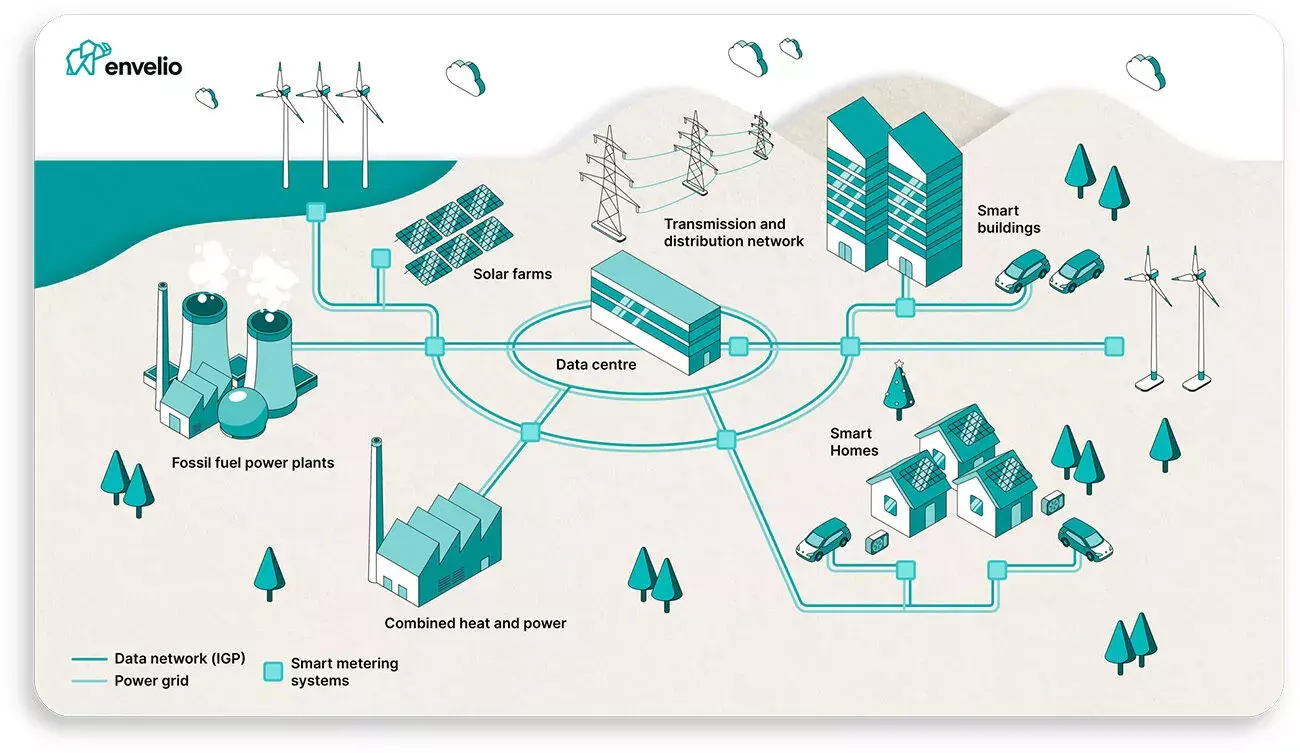
All the benefits of automatically managing and optimizing energy use in buildings come together in a systemic approach called the smart grid. The smart grid is designed to balance and distribute energy consumption across different areas according to load. An important component of this system is also on-site microgeneration of energy.
The US and the EU are actively working to build smart grids and spending enormous sums on it: the global market for these systems is estimated at 174 billion dollars by 2014. Technology giants are buying up suppliers of such solutions for staggering amounts: Toshiba alone acquired two such firms for 2.3 billion dollars in order to become the leader in the smart grid market.
As a result, a major recent trend is the shift away from a centralized energy generation system toward distributed generation. And for Russia, this is step one. Abroad, priority is now given to systems with the most closed fuel cycle possible: hydroelectric plants, wind generators, PV panels, tidal power stations, and (looking ahead) fast-neutron nuclear reactors.
Step two is managing the energy consumption profile. This means controlled consumption (smart washing machines, for example) and dynamically changing tariffs that reflect generation conditions.
Step three is energy saving, and then more energy saving. In a year's time, the use of automation for this purpose becomes mandatory in all public buildings across the EU. From 31 December 2018, all new public buildings must be «zero-consumption» buildings — that is, almost entirely self-sufficient in energy — and from 31 December 2020, all new buildings in the European Union must be «zero-consumption».
The new building model combines «passive house» technology with microgeneration (thermal and electrical) and active energy saving. The result is that same «zero-consumption» building.
Why go to all this trouble? The answer is simple: the energy cost of extracting oil has grown tens of times over the past 100 years, and oil production will only decline. So the smart grid marks the first steps in preparing for the world «after oil». The smart grid has not yet been standardized, but it is safe to say it will be built with the ability to carry data over IP.
Related news
Schneider Electric — Leader in the Ranking of BMS Suppliers
SmartStruxure is a new platform developed by Schneider Electric specialists that offers a line of hardware and software products for the Building automation systems segment. Schneider Electric is a major French engineering company that develops and manufactures power management solutions as well as integrated energy-efficiency solutions for the energy and infrastructure sectors, industrial enterprises, civil and residential construction, and data centers.

Schneider Electric Partner Meeting
Schneider Electric is a major French engineering company that develops and manufactures power management solutions as well as integrated energy-efficiency solutions for the energy and infrastructure sectors, industrial enterprises, civil and residential construction, and data centers. The corporation includes such companies as Merlin Gerin, Square D, Telemecanique, MGE UPS Systems, TAC, APC, Clipsal, Andover Controls, Merten, and Pelco. Today the company operates more than 200 plants. It produces low- and medium-voltage electrical equipment and automation products for industry and residential construction. The company employs 152384 people (2012 data). The company's revenue in 2012 amounted to 23.946 billion euros.

Energy-saving Echelon systems for street lighting control
Quebec City (Canada) has begun using a new street lighting control system based on LonWorks® Power Line technology, which transmits data over the power grid's electrical lines.